Just north of the Golden Gate Bridge there’s supposed to be a city of at least 30,000 people. Probably it would have been a lot larger by now.
Except it’s not there. In today’s story, I’m going to share how a rag-tag group of environmentalists and local activists defeated the deep pockets of a mega-corporation.
SF and the rise of the ‘burbs
After World War II, suburbs with what some called “ticky-tacky houses” were springing up all over America.
At the same time in San Francisco, a robust military presence was declining as U.S. forces shifted their focus towards Los Angeles and San Diego.
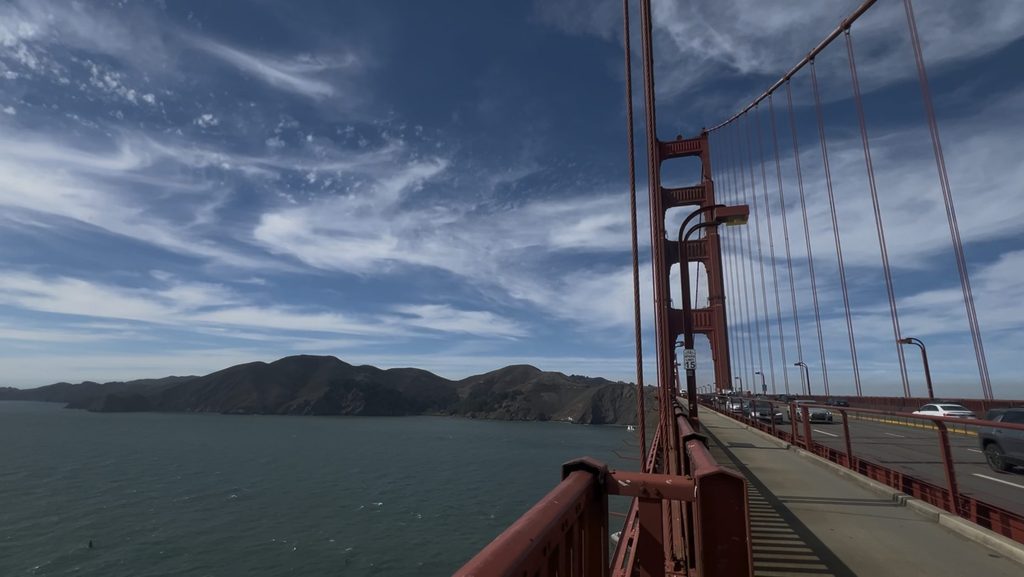
In the Marin Headlands, just across the Golden Gate Bridge, a vast tract of undeveloped land called out to developers. Here was prime real estate right next to a major American city, owned by a military which had decided to divest itself of the land.
The Marin Headlands had been the home of Coastal Miwok tribes for countless generations before the Spanish arrived in 1775. Under Mexican rule, the land belonged to a succession of cattle ranchers, including William Richardson, founder of Sausalito, and Samuel Throckmorton. After San Francisco became a key American possession, the military developed a series of defensive bases and batteries to defend the coastline — sites like Battery Spencer, Battery Rathbone McIndoe, and Fort Cronkhite.
With the military departing in the early 1960s, the Gulf Oil Corporation purchased the land.
Real estate developers had already begun to encroach on longstanding green space around San Francisco, with planned development along the Point Reyes seashore and a water park to take over Bolinas Lagoon.
But the Marincello development was different.
The Marincello project
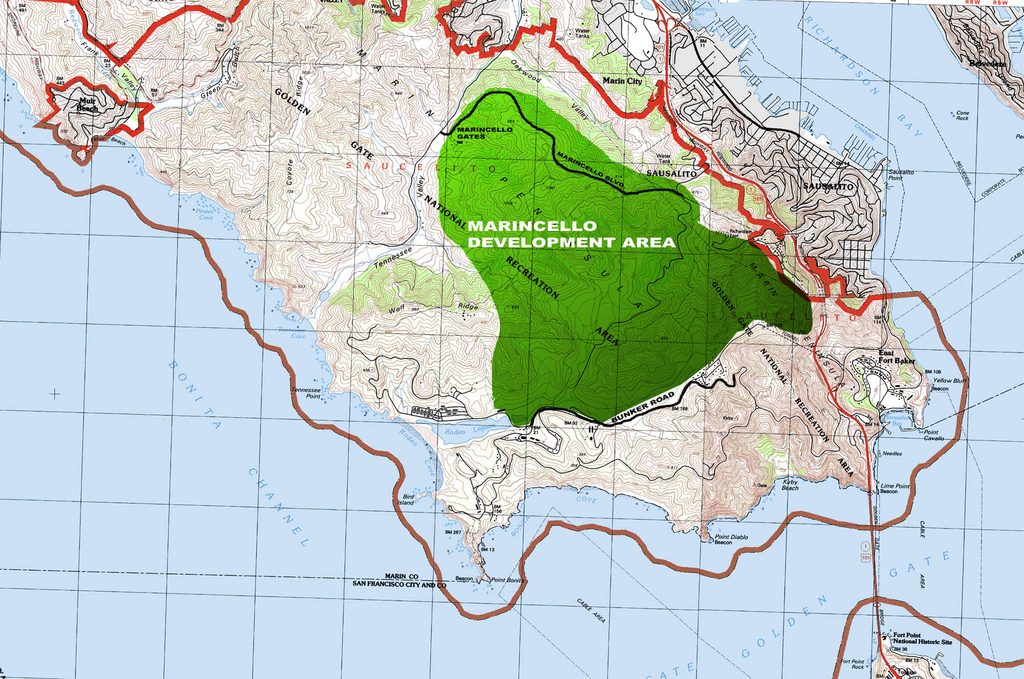
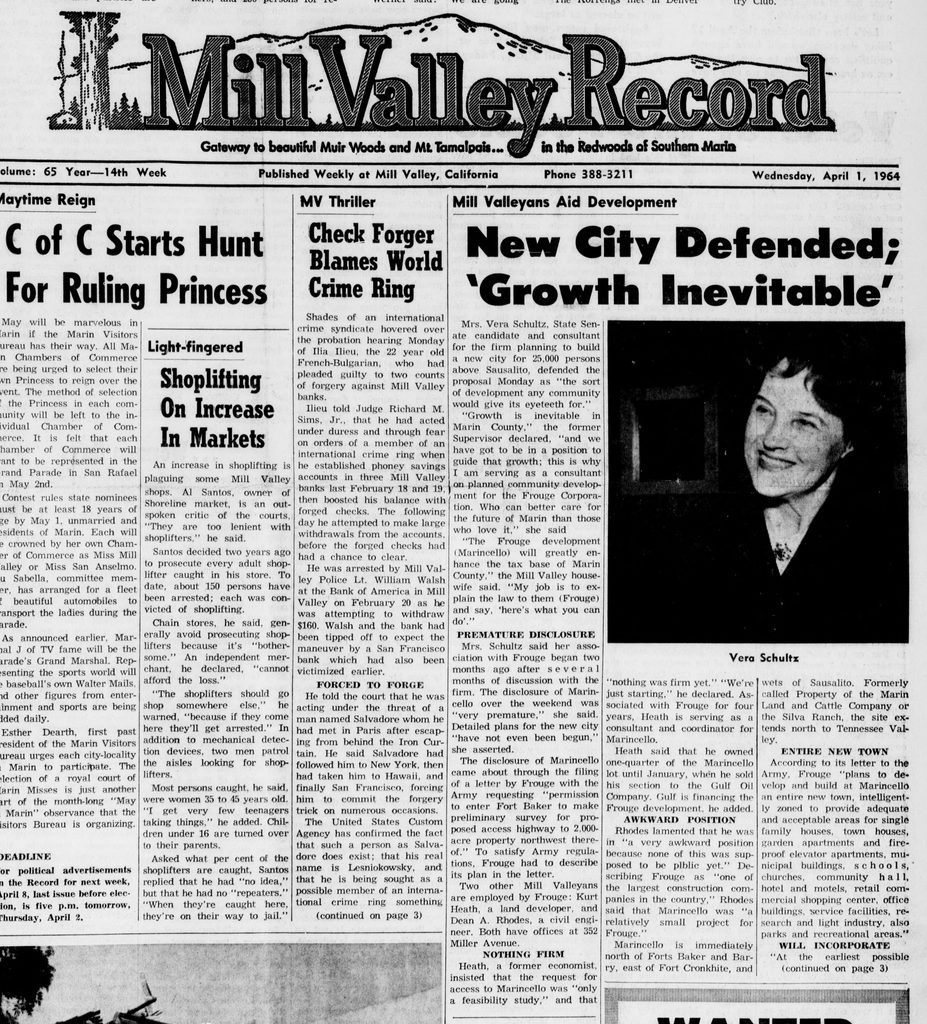
In collaboration with Thomas Frouge, a developer from Bridgeport, Connecticut, Gulf Oil planned to construct a new community, a suburban city nestled in the valley stretching from Rodeo Beach through the whole of what is now known as Gerbode Valley. At various times discussed as a development for 20,000, 30,000 or even more people, Marincello would include a mile-long mall with a series of parks and activity areas, shopping areas, a series of 17 waterfalls, offices, light industry, and 50 apartment towers, some of which were intended to reach as high as 16 stories.
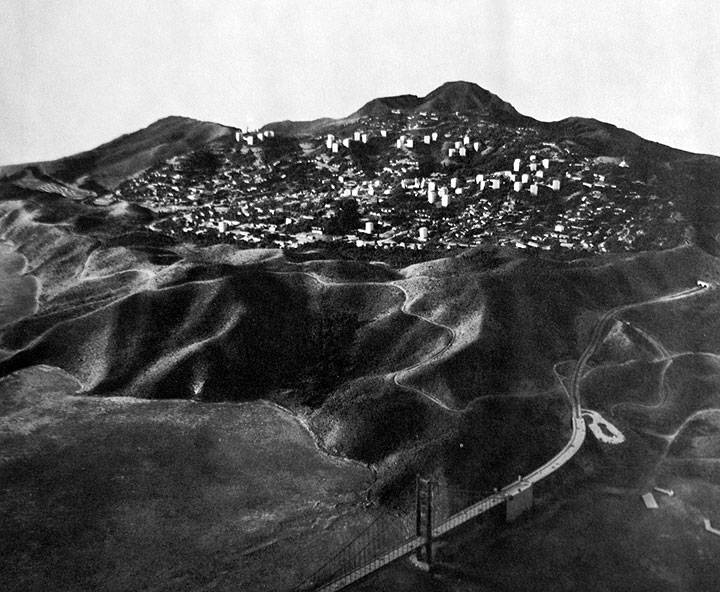
Frouge looked at this amazing opportunity and said, “It is probably the most beautiful location in the United States for a new community.”
But environmentalists and neighboring communities were incensed at the idea. Not only did Frouge’s plan encroach on an area of great beauty and biodiversity, but the new city, if allowed, would surely grow and likely overwhelm the relatively small town of Sausalito, which sits just the other side of the hill.
Plus — let’s face it — there’s just something freakin’ cool about this amazing piece of natural land right across from a major urban center, separated by the most famous bridge in the entire world.
And it almost certainly wouldn’t have stopped with the original plan. Once the precedent was set, what would stop the city from growing from 20,000 to 30,000 or really to any size at all. Located as close as it was to San Francisco, it’s likely that Marincello would have grown far larger still.
But the tide of suburban development was pushing forward with all the subtlety of a runaway train.
In 1965, despite significant pushback from the local community — including petitions which the local government ignored — the Marin County Board of Supervisors approved the Marincello plan. Development of the Headlands was inevitable, they said, and if Gulf Oil’s planned community didn’t happen, the result could be nothing but chaotic development with a far worse impact on local cities and the environment.
The opposition
But those opposed to Frouge and Gulf Oil didn’t take this defeat lying down. And importantly, not everyone who participated in the struggle against this corporate behemoth did so for the same reasons.
“When enough people care enough and work hard enough, long enough, the right thing will in time happen despite what would appear to be permanent setbacks.”
California State Senator Peter H. Behr
In 1966, the city of Sausalito sued the developers, largely over NIMBYist fears of how a neighboring city of 30,000 or more people would affect their little town of just 7,000.
Three lawyers, Robert Praetzel, Martin Rosen, and Douglas Ferguson, began to find technical arguments to delay the project. Robert Praetzel, who found numerous instances of illegality in the planning process, said, “I just felt it was terrible that these few people could turn around an entire landscape, and not even consult the local citizens.”
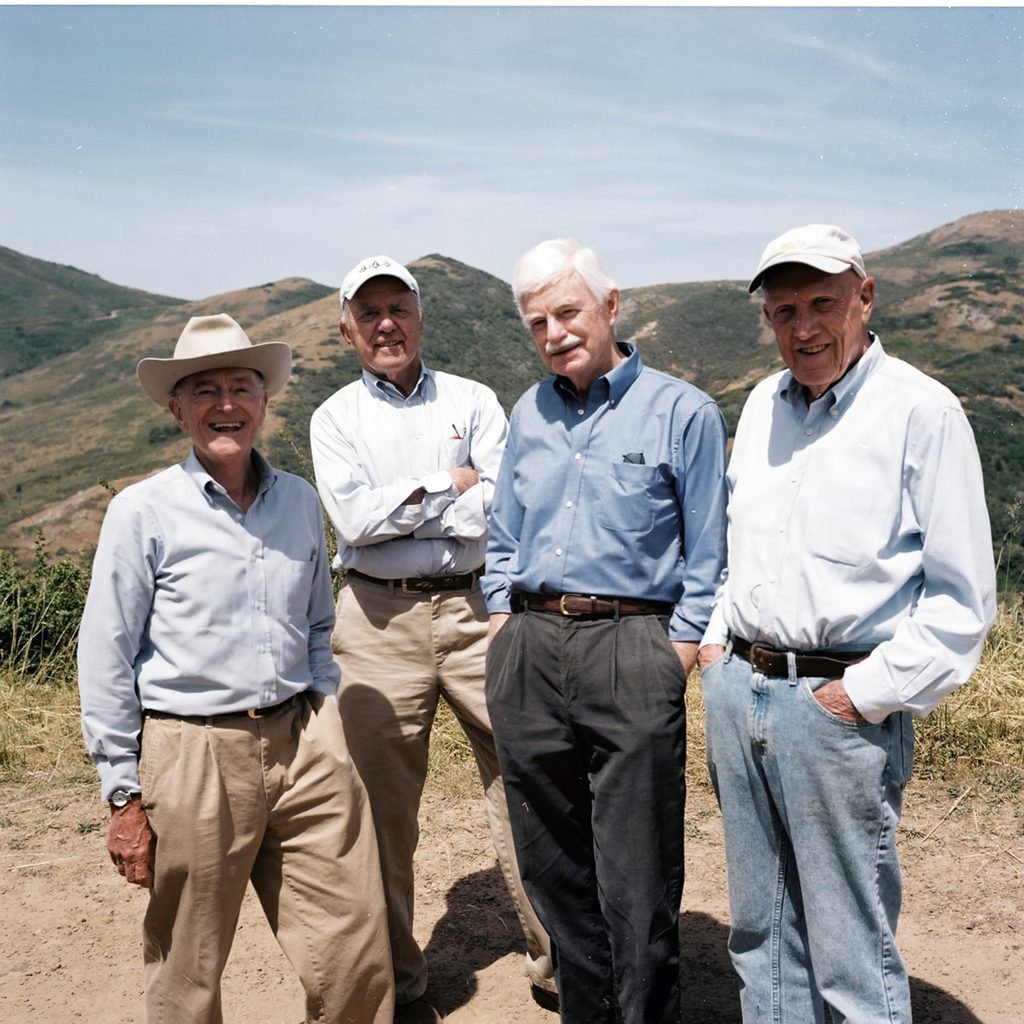
The Nature Conservancy, led by its Western Regional Director, Huey Johnson, began behind-the-scenes talks with Gulf Oil. The oil executives laughed at him, asking how long his tiny organization could hold out against the corporation’s endlessly deep pockets. He laughed back, “What you don’t understand,” he told them, “is that our guys are unpaid and they’re crazy.”
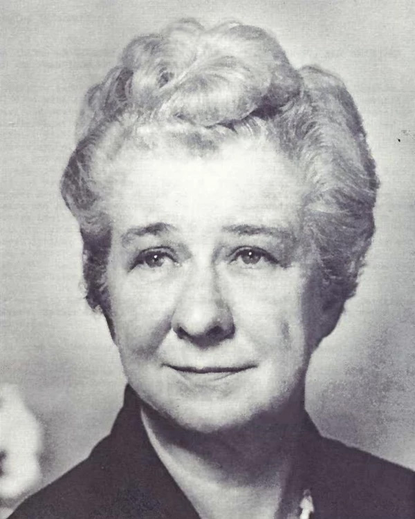
And Johnson had the backing of people with considerable funds. Martha Gerbode, a well-to-do San Francisco socialite, told him “Don’t bring me any projects that other people would fund. I just want the tough, controversial ones.” Her money provided a financial backbone to help resist back up Johnson’s crazy, unpaid lawyers.
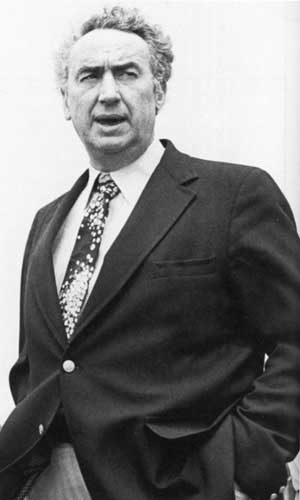
Congressman Phillip Burton campaigned tirelessly to protect the Marin Headlands. Burton was not an environmentalist. He was quoted as saying that the only time he went outdoors was for a smoke. But he knew which way the political winds were blowing. When Edgar Wayburn of the Sierra Club proposed a five square mile park to be what ultimately became the Golden Gate National Recreation Area, Burton asked him if that was what he really wanted. Wayburn admitted that he wanted more, but didn’t think it was politically feasible.
“Get the hell out of here!” Burton shot back. “You tell me what you want, not what’s politically feasible. I’ll get it through Congress.”
Things fall apart
This mountain of opposition — not one titanic struggle, but an endless succession of little ones — wore away at Gulf Oil’s patience. While construction of Marincello had begun soon after Marin County had approved it in 1965, by 1968 all they had to show for their years of effort was a gatehouse and the beginnings of a couple roads. Frouge and Gulf Oil fell to infighting and their own legal battles.
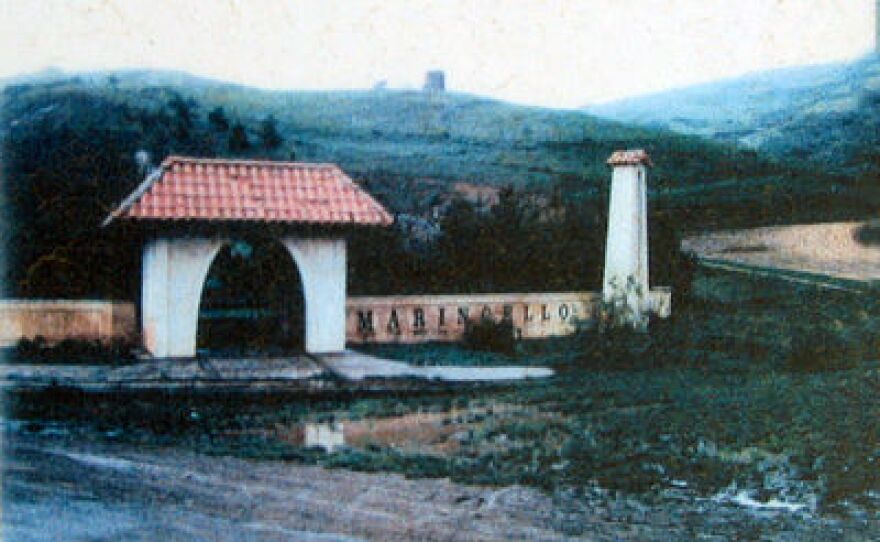
Then, in January of 1969, Thomas Frouge died of a cerebral hemorrhage. While this didn’t immediately kill the project, it certainly took the wind out of its sails.
In October of 1970, on the same day the Frouge’s estate and Gulf Oil finally settled their long-running legal dispute, a court ruled that the entire Marincello project had been approved on illegal grounds. If they wanted to proceed, the court said, they’d have to start all over again.
Rise of the GGNRA
As all this was happening, a new idea had been bubbling up. Led by Ed Wayburn and Phillip Burton, and spurred by Native American occupation of Alcatraz island between 1969 and 1971, San Franciscans had begun to lobby for the creation of the Golden Gate National Recreation Area. The GGNRA was to be composed of old military land, ranches, and greenspace, covering 80,000 acres, stretching from San Francisco to Point Reyes, and it would include the Marin Headlands.
When President Richard Nixon endorsed the plan, it was clear that Marincello had no future.
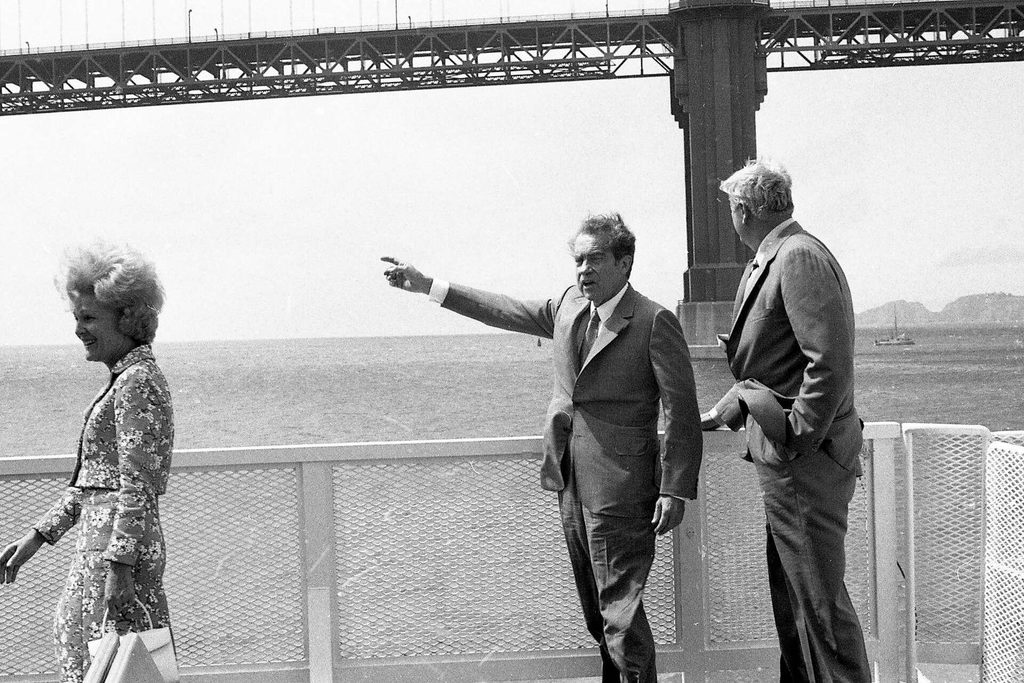
Defeated, Gulf Oil at last sold its stake to the Nature Conservancy for $6.5 million dollars. The land was then turned over to the U.S. Parks Service.
Inevitability
The “inevitable” development of the Marin Headlands never happened.
I wouldn’t advise you to trust anyone who tells you that they know the inevitable future.
Look around today, and you’ll see much the same arguments around AI Data Centers. It’s the same argument made for decades around fossil fuels. These things are inevitable, we’re told. And many of those telling us this believe it…because it’s easy to convince yourself of something that also happens to be in your financial interest.
But nothing is inevitable. “When enough people care enough and work hard enough, long enough, the right thing will in time happen despite what would appear to be permanent setbacks.”
Every year, an estimated 19 million people visit the GGNRA
I write about things which interest me, including the City of San Francisco, and the subject of writing itself. I’m also working on a novel.
Please consider subscribing to my blog.
Leave a Reply