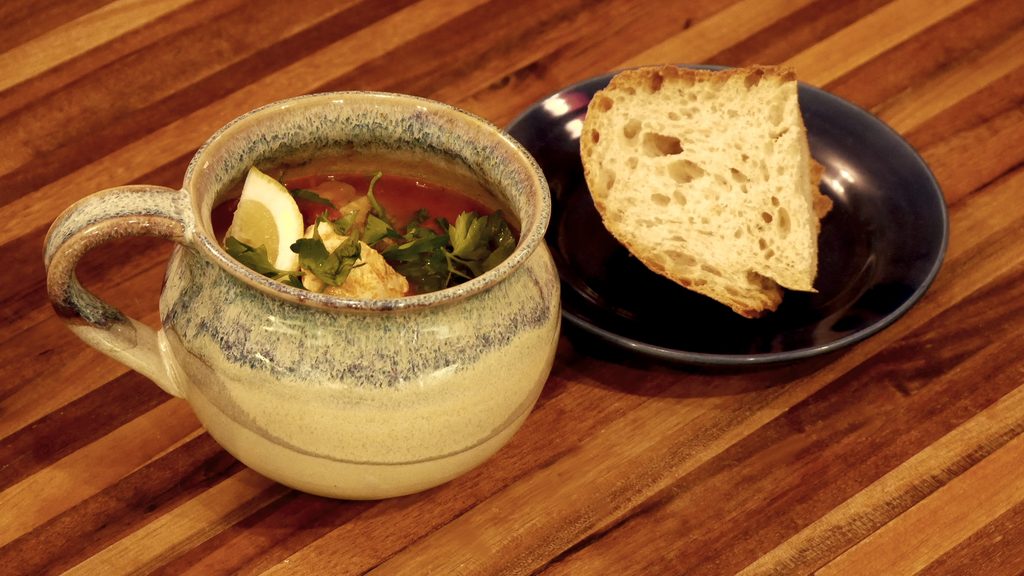
Talking chowder
As a tour guide in San Francisco, I get asked one question a lot, a question as perfectly predictable and it is bizarre.
“Where can I get a great bowl of clam chowder?”
Now look, I like clam chowder as much as anyone. It’s delicious. But despite an army of restaurateurs who’ll argue otherwise, it ain’t San Franciscan. The proper name of the chowder popular in San Francisco — and there’s a subtle hint in the name — is “NEW ENGLAND clam chowder.”
Shoutout to the good folks of New England.
The only thing San Francisco did — and not a terrible innovation, by the way — was to put that delicious, creamy soup into a loaf of our delicious sourdough bread.
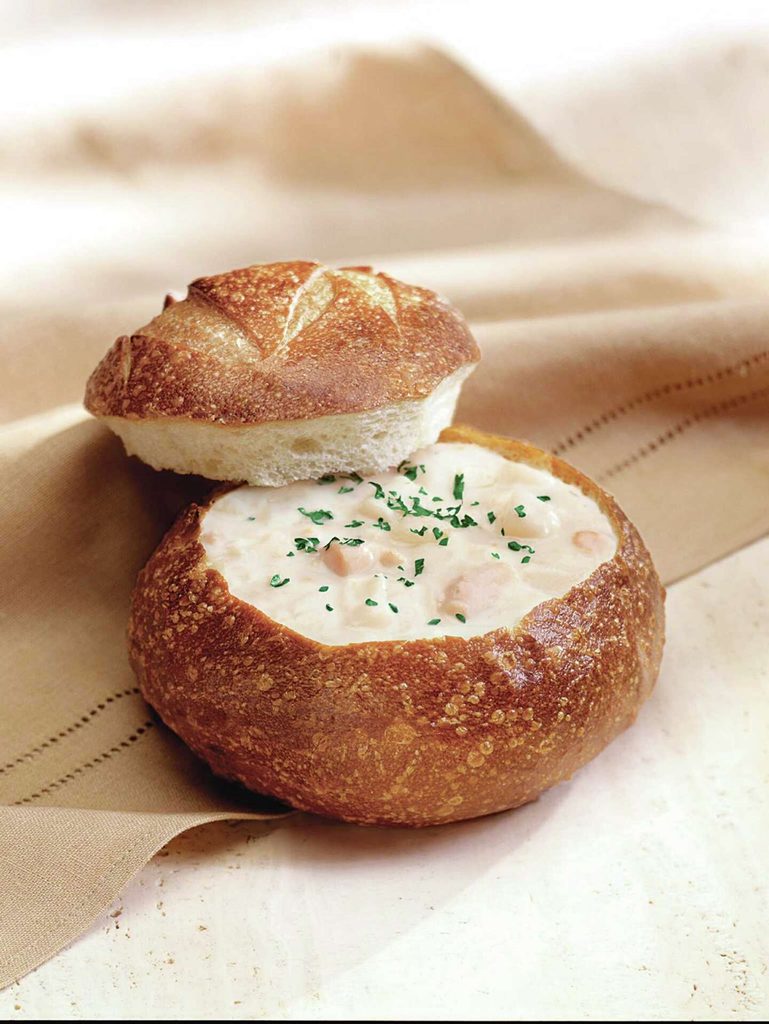
San Francisco Clam Chowder
Johansen Krause, 2019
Yes, we’ll use Pacific instead of Atlantic clams, and arguably there are other subtle differences, but the popularity of clam chowder in SF is far more of a sales gimmick for tourists than anything genuinely, uniquely San Franciscan.
But if you like seafood and soup and want something truly San Franciscan, what you need to look for is the subject of today’s story. I would argue that the most truly San Franciscan dish of them all has to be cioppino!
Of wealth and generosity
A friend of mine recently commented how it seems that the poorest among us are often the most generous. It’s as if those of us who’ve been fortunate cling even harder to what we have, while it’s mostly those who feel fortune’s friction who actually remember and sympathize with those in need.
Cioppino is a dish that springs from community and generosity. It’s not just food. It’s a tangible reminder of the idea that kindness can be its own reward.
Today I’ll dig into this dish’s backstory. I’ll also mention some of my favorite places to try cioppino, and then show you how you can make this delicious dish for yourself.
A poor man’s dish
There’s no precise inventor of cioppino and no specific date. In fact, you could even make the case — not unlike what I’ve already said about clam chowder — that the dish isn’t even really San Franciscan.
Cioppino comes from a long tradition and has a dozen cousins from around the Mediterranean, dishes like “bouillabaisse” from Provence, “cacciucco” (ca-CHU-ko) from Tuscany, and “kakavia” from Greece. These dishes all combine fish, onions, olive oil, seasoning, usually adding stock and tomatoes.
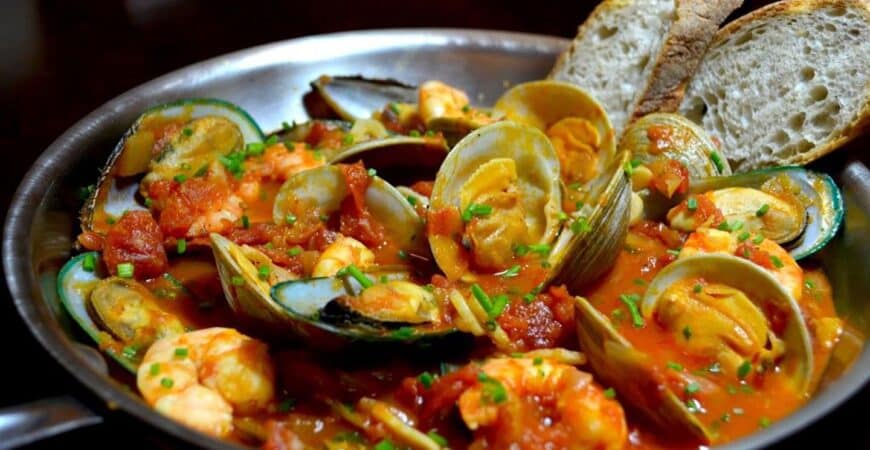
Cacciucco
Photographer and date unknown
And importantly, they all go back to the idea of a poor man’s dish, a peasant dish of fish scraps or leftovers being turned into something magical.
But cioppino is a bit more than a slight variation and has its own wonderful history right here in San Francisco.
Meiggs wharf
It’s important to note that food creation lore is often riddled with as much fantasy as reality, so the story of cioppino will likely never be known precisely. But its creation is said to go back to a place called Meiggs Wharf…a pier which once began near the corner of present-day Powell and Francisco Streets, and stretching a couple thousand feet north through present day Fisherman’s Wharf.

Until it burned in the fire which followed the 1906 earthquake, Meiggs Wharf was a popular spot with local fishermen, particularly Italians from Genoa. These fishermen were exceptionally poor, often living and working their lives away on a single small fishing boat which served as both workplace and home.


Thomas Houseworth & Co, Circa 1870
Cioppino emerged from among these fishermen. If someone had a poor haul on any given day, he could carry a pot to his fellows, and each would pitch in a scrap from their own catch.


D.H. Wulzen, 1899
OpenSFHistory / wnp71.10092
From this, the unfortunate fisherman could make a stew to feed his family. Perhaps tomorrow, he’d be the fortunate one, and then he’d chip in to help the next fellow in need.
“Chip-in-O”
In fact, another common tale suggests that it’s this practice of sharing or “chipping in” that gives the stew its name. That the word is really English with a comically staged Italian accent where all the fishermen would “chip-in-o” to help others out.
Sadly…or fortunately…this folk etymology is nonsense, and most serious word-sleuths and kitchen historians trace cioppino’s origins to another soup from this same family, the Ligurian “ciuppìn” (chyew-PEEN). Various sources suggest that the word “ciuppìn” either means “lightly chopped” or “small soup.” In either case, the name likely derives from the idea that one made this soup from offcuts and otherwise uselessly small fish.
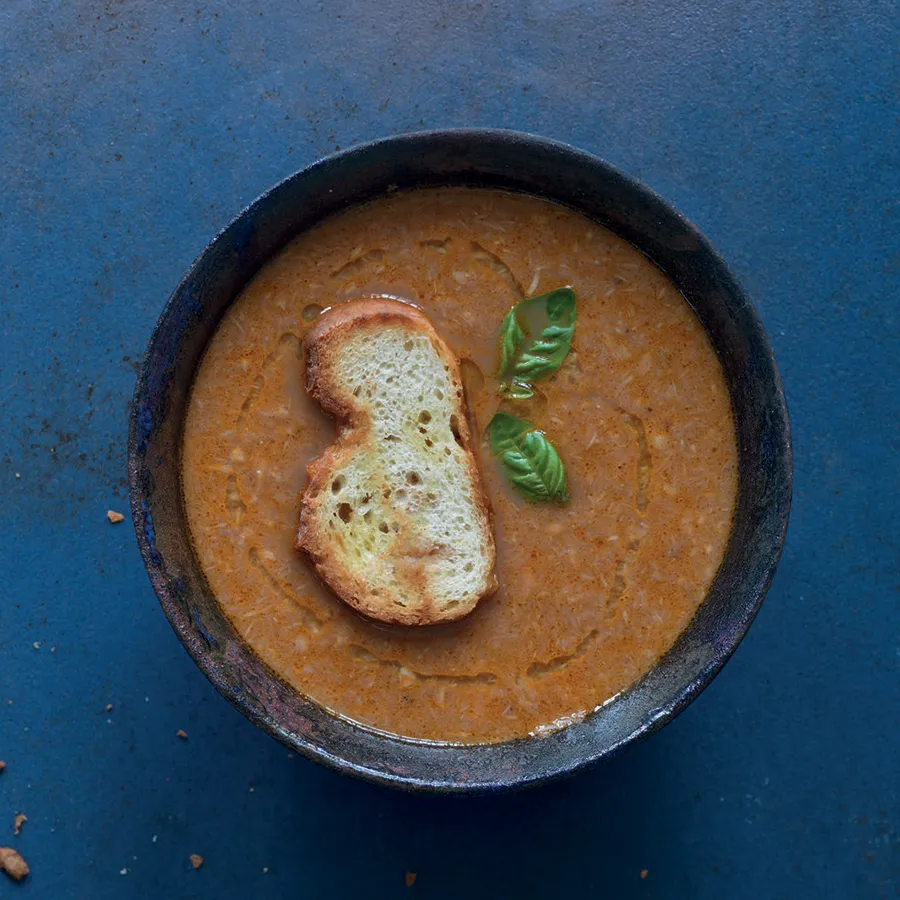
Photographer and date unknown
To jump back to my dismissal of chowder as a San Francisco dish, what then makes cioppino different from ciuppìn? Well, there are three major differences. First, ciuppìn was generally served as a smoother puree, while San Franciscan cioppino is left hearty and chunky. Second, cioppino uses more tomatoes, some think by the influence of Sicilian fishermen. Finally, and most importantly, the addition of chili peppers, a key ingredient that lends our version more heat than its Genoese cousin.
(And despite that distinction, plenty of cioppino recipes will omit the chilis…there’s a certain anything goes aspect to cioppino.)
Increasing popularity
From its humble beginnings at Meiggs Wharf, cioppino spread out into broader San Francisco Italian culture, and by 1901 an early recipe for cioppino found its way into a newspaper catering to a broader, non-Italian audience.
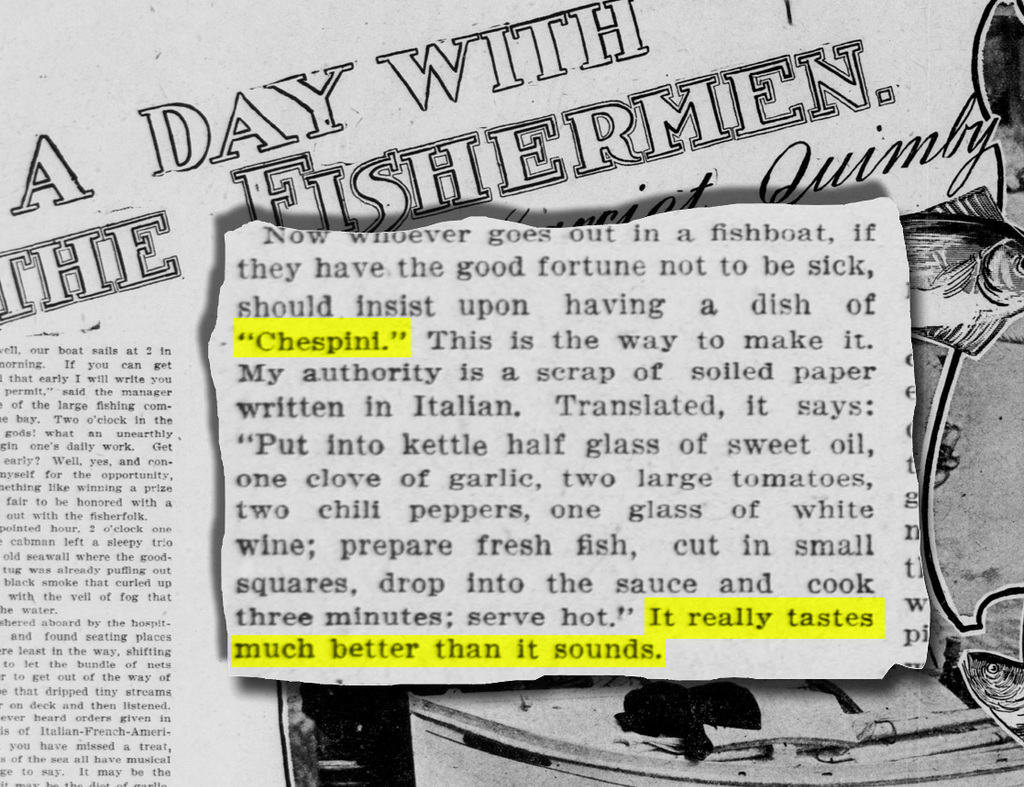
Put into kettle half glass of sweet oil, one clove of garlic, two large tomatoes, two chili peppers, one glass of white wine; prepare fresh fish, cut in small squares, drop into the sauce and cook three minutes; serve hot.
Here the dish is called “chespini,” but from the recipe there’s no question that we’re looking at an early version of cioppino.
Rather amusingly, the author of this piece felt obliged to note that this fishy concoction “really tastes much better than it sounds”…a nod perhaps to how alien this dish sounded to the paper’s largely Anglo readership.
A few years later, shortly after the Great Earthquake and Fire, one can find another recipe for cioppino in the 1906 “Refugee’s Cookbook.”

Take a good sized solid piece of fish (bass or white fish), put in a pot with one can of tomatoes, one onion sauteed in butter, two pepper pods, one bay leaf, juice of one dozen clams, cook briskly one hour; fifteen minutes before serving add one dozen clam bellies.
You’ll notice that the spelling — either by error or evolution — hops around like a tripping frog at a Grateful Dead concert. I’ve seen it spelt chespini, chipini, chipinne, chopino, ciopino, cioppino, chioppinno, and about a dozen other ways.
Cioppino began to appear on menus around California in the years that followed. But it remained a relatively obscure offering largely confined to the west coast until after World War II.
Restaurants
Lots of San Francisco restaurants — especially those specializing in Italian and/or seafood fare — serve cioppino. Two of my favorites are:
Sotto Mare, a busy, noisy, full-of-energy Italian hotspot on Green Street in North Beach.
Or, if you prefer your seafood in a quieter setting, try Anchor Oyster Bar in the Castro.
Recipe
At its heart, cioppino is simply a tomato-based sauce with seafood. Nearly every ingredient is fungible. Some folks insist on fresh tomatoes, others will use red wine instead of white. I tend to go lighter on onions and garlic than many.
Here’s the variation used in my video. Would likely serve about 6 people. * Allow roughly an hour to ninety minutes cooking time.
Ingredients
Sauce
- ¼ cup olive oil
- 1 bulb fennel
- 1 onion
- 2 cloves garlic
- 1 tsp crushed red pepper flakes
- 2 tbsp tomato paste
- 1 cup dry white wine
- 2 28 oz cans San Marzano whole peeled tomatoes
- 2 tsp sea salt
- 1 bay leaf
- ½ tsp dried oregano
- Zest of one lemon
- 4 cups good quality seafood stock
- Fresh ground black pepper
Seafood
The seafood can be just about anything, whatever’s fresh. Just make sure everything is free of bones, skin, and grit. I usually cut things into bite-sized chunks.
Traditional ingredients include firm white fish, mussels, clams, crab (especially Dungeness crab), and prawns. I used what was best at my local fish shop that day:
- 1 lb clams (cleaned, soaked in water for 10 minutes)
- 1 lb halibut (skinned, deboned, cut into bite-sized chunks)
- 1 lb red snapper (skinned, deboned, cut into bite-sized chunks)
- 1 lb prawns (peeled and deveined)
- ½ lb (8 count) scallops *
Garnish
- Lemon wedges and Italian parsley
* I was serving just four people, and the number of scallops (the most expensive ingredient in my list) — two per person — reflects that fact.
Method
- Heat the oil in a large stockpot or dutch oven. Fry the onion and fennel until soft and translucent, about 8-10 minutes.
- Add the garlic and red pepper flakes. Cook, stirring, for about 1 minute. Add the tomato paste, stir, then add in the wine. Cook for 2 minutes.
- Stir in the canned tomatoes, salt, bay leaf, oregano, lemon zest, and seafood stock. Simmer this sauce for about thirty minutes to an hour, stirring occasionally with a wooden spoon. Break up the tomatoes as you go.
- About fifteen minutes before you’re ready to serve, add the clams to the top of the sauce, steaming until the shells open. Remove the clams, discarding any that haven’t opened.
- Now add all the other seafood in the order necessary to have everything done at about the same time. If you’re unsure about cooking times, ask your fish provider, but usually all of this happens in the space of just a few minutes. Most fish and prawns want to turn white, but be careful of overcooking. (In my version, scallops are the most delicate item and only take about 3 minutes.) When done add the clams back in for the last thirty seconds or so, just to reheat.
- Serve into a bowl, garnished with a lemon wedge and chopped Italian parsley.
Serving suggestions
I usually just serve cioppino with fresh sourdough bread. Pasta isn’t uncommon. Pair with a good quality dry white wine.
I write about things which interest me, including my upcoming fantasy novel, the city of San Francisco, travel, and sometimes food.
If you find what I do interesting, please subscribe to this blog.
Leave a Reply