What makes you a citizen? Most of us simply assume that our citizenship is what it is based on where we’re born. We don’t choose our citizenship any more than we choose the color of our eyes.
But this is the story of a San Francisco man forced to fight for his citizenship. Wong Kim Ark, whose battle defined what it means to be an American.
Born in San Francisco
Wong Kim Ark was born in San Francisco sometime between 1868 and 1873. In those days (entirely unlike today) Americans would find ways to hate and exclude their fellow Americans, usually on account of race or religion. And politicians and powerful people would find ways to exploit that hatred and exclusion to suit their own purposes.
Again, something which would never happen today.
Wong’s parents had come to the United States from Guangdong, China. Like most immigrants back then, they came seeking economic opportunity and a chance at a better life. They ran a grocery store on Sacramento Street in San Francisco, where Wong Kim Ark was born. After race riots and lynchings in 1877 killed many residents of Chinatown, his parents fled back to China.

Returning home to the U.S. a few years later, Wong worked hard as a dishwasher and cook in San Francisco and at mining camps in the Sierra Nevada, raising money to support his family back in China. He even managed to visit that family twice, though the journey was long and expensive.
Denied entry
On his second return journey, though, the collector of customs in San Francisco, a man named John Wise, stopped Wong and told him that the law now forbade him from reentering the United States.
Wong protested, “I’m an American citizen. I was born here. I even have papers signed by white men, as the law requires, stating that they’ve known me since I was a child.”
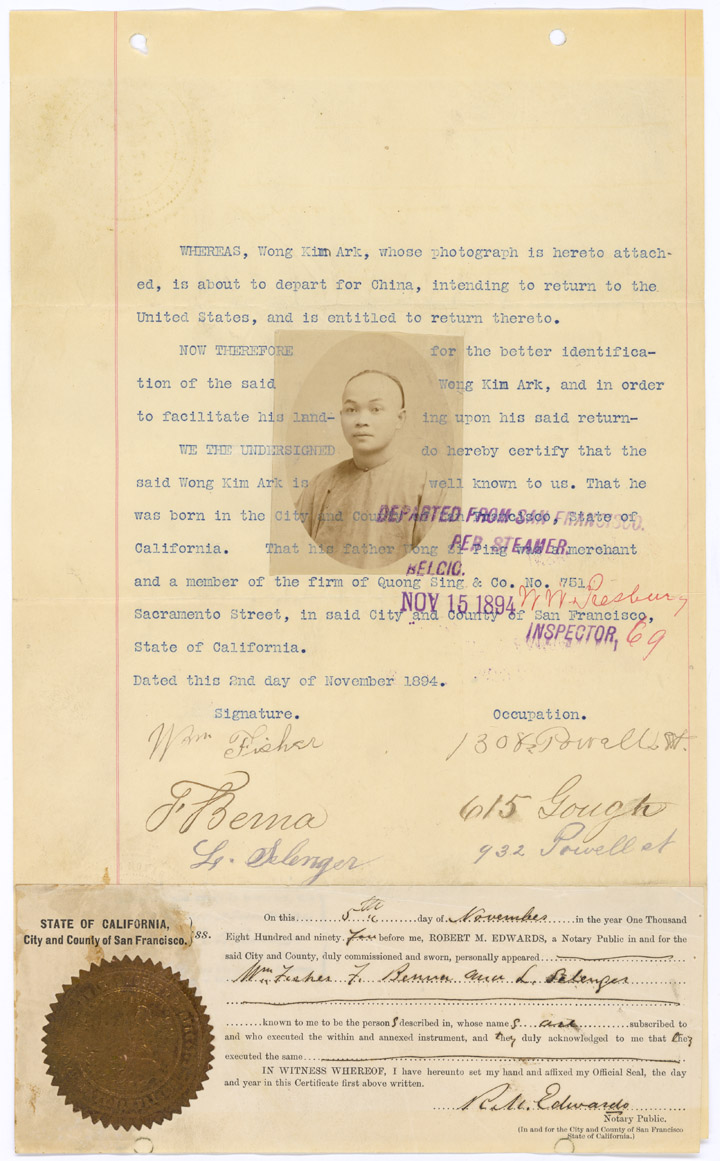
It wasn’t that John Wise didn’t believe Wong Kim Ark. In fact, he did. He knew that Wong had been born in the United States. Wise had been searching for someone exactly like this: a Chinese man born in the United States to parents who had come from China.
Powerful men, including the President of the United States, had passed a law in 1882 — the Chinese Exclusion Act — which made it illegal for Chinese people to immigrate to America. They had forbidden all Chinese laborers and all Chinese women. Now John Wise — and those who supported his cause — wanted to go further…preventing even a Chinese person born in the United States from becoming an American citizen.
But an organization called the Chinese Six Companies came to Wong’s defense, hiring lawyers to represent him in court.

Wong, forced to live in harsh conditions on a steamship just off the coast of San Francisco, waited months while lawyers argued his case in District Court.
A test case
And in fact, his lawyers won. But the government immediately appealed the judge’s decision all the way to the U.S. Supreme Court. This is, in fact, exactly what they’d wanted…to create a test case and an opportunity for the court to strip Chinese Americans of their citizenship.
Wong had good reason to be fearful of the outcome. Under the direction of Chief Justice Melville Fuller, the Supreme Court wasn’t known to be sympathetic to Chinese people. In fact, at this time it had a reputation for extreme racism. In the case of Plessy v Ferguson it had established the idea of so-called “separate but equal” treatment between races. It had upheld poll taxes and literacy tests designed to exclude black people from voting. And it had supported the Chinese Exclusion Act, the very law paving the way for the position Wong now found himself defending.
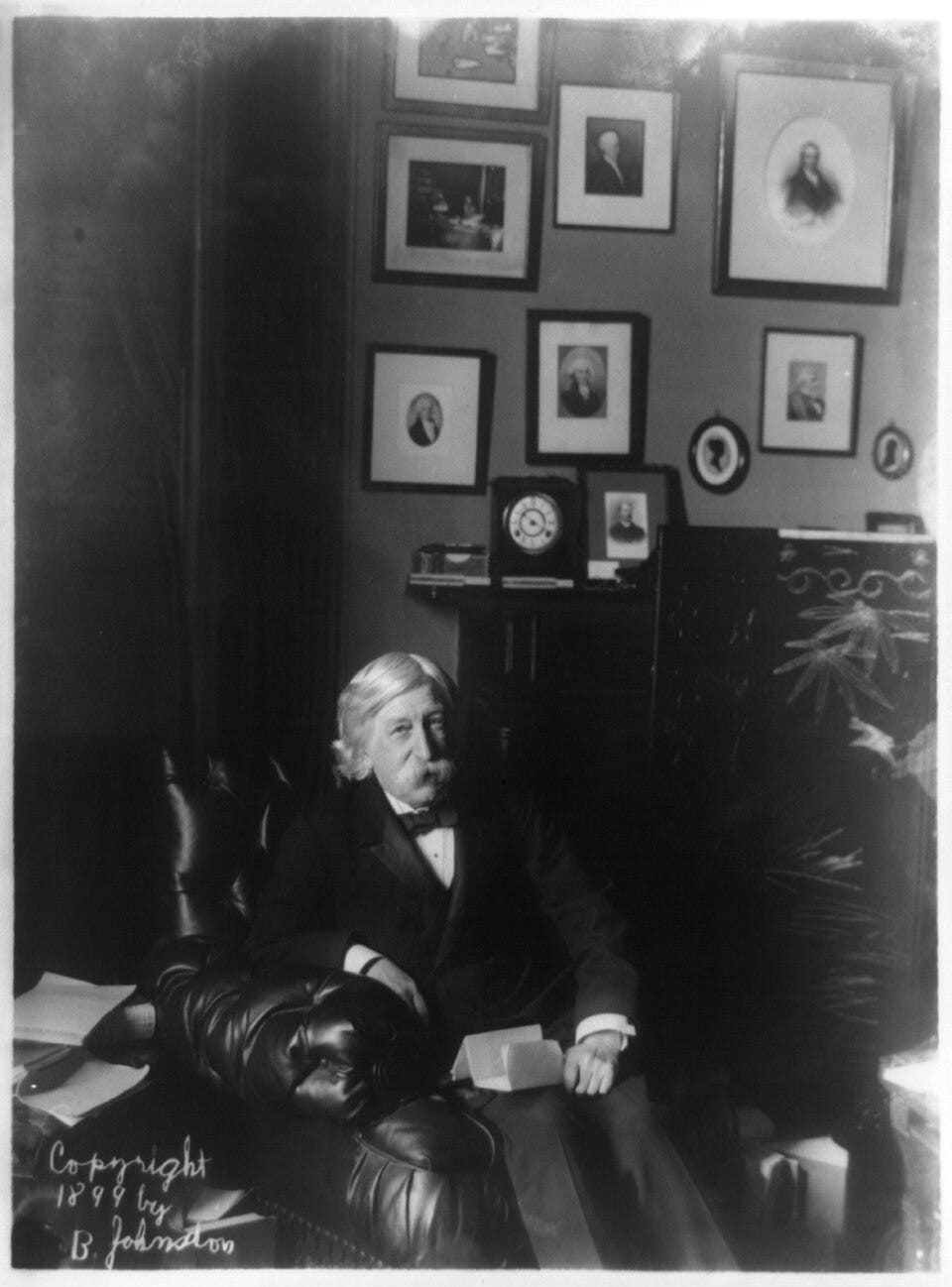
The question before the court was simple, but profound: since the United States was founded, it had been assumed that anyone born on U.S. soil was automatically a citizen. This idea, known as jus soli (yoos SOL-ee), came from English common law. But the reality was that it was more of an assumption than a law. This had never been tested at the nation’s highest court.
In every generation, we get to relearn an important lesson. Many of the assumptions we hold regarding how our nation functions are just that: assumptions. Unless we actively strive to shape the future, others will do so on our behalf. And not always to our benefit.
United States v Wong Kim Ark
The two sides met and debated in Washington D.C., in March, 1897.
The case turned on a key piece of text in the 14th Amendment, adopted just after the end of the Civil War…
“All persons born or naturalized in the United States, and subject to the jurisdiction thereof, are citizens of the United States and of the State wherein they reside.”
The government seized on the phrase ‘subject to the jurisdiction thereof.’ Arguably, this phrase could have two different interpretations. The traditional understanding had been so-called ‘territorial’ jurisdiction. Simply put, if you’re in someone’s house, you have to follow their rules. This type of jurisdiction applies to nearly everybody.
But the government’s lawyer, solicitor general Holmes Conrad, proposed a different reading. ‘Subject to the jurisdiction thereof’, he said, meant ‘political’ jurisdiction. Which is to say: if I walk into your house, I may be a guest, but I neither gain nor lose any rights by doing so. Under this reading, a child born in the United States doesn’t automatically become a U.S. Citizen. If a parent didn’t have that right, the child doesn’t either.
.jpg "Black and white portrait photo of Holmes Conrad")
The 14th Amendment was enacted explicitly to provide citizenship to previously enslaved people. Conrad was inviting the court to throw that purpose into doubt.
And then Conrad went further. In his brief he stated that the defeated Confederacy had approved the 13th, 14th, and 15th Amendments only because they’d been coerced at the end of the war. He was saying that these amendments were themselves unconstitutional. That, in effect, the Supreme Court should undo the outcome of the Civil War.
With this a shiver might well have run down the spine of Wong Ark Kim, through the entire courtroom. Might well have shaken every person in America. What Holmes Conrad was questioning was the very foundations of the idea that all men were created equal. He was arguing that America was solely the property of white men.
Wong Kim Ark was represented by Joseph Hubley Ashton, who’d served as a U.S. Assistant Attorney General under Abraham Lincoln. He was a friend of Walt Whitman, and a fierce defender of birthright citizenship. Ashton’s point was simple and very clear.
If the protections guaranteed by the Constitution could be manipulated to exclude Chinese people born on U.S. soil, how was it supposed to defend anyone else? Why couldn’t a different government with different prejudices exclude former slaves? Or immigrants from Italy? Or Ireland? Or England? If John Wise and Holmes Conrad and their philosophy were allowed to prevail, any American citizen could have their citizenship — and thus their rights — stripped away.
Awaiting a decision
It took more than a year for Fuller’s Supreme Court to reach a decision. By that time, Wong Kim Ark — and all the other Chinese Americans who’d be affected by the outcome of his case — had been waiting two-and-a-half years for an answer.
When the ruling at last came down, Justice Horace Gray wrote for the court that the object of the Fourteenth Amendment was “restricted only by place and jurisdiction, and not by color or race.”
They supported jus soli and the Fourteenth Amendment, and would not endorse Holmes Conrad’s interpretation that “subject to the jurisdiction thereof” suggested that children on American soil could not be citizens because they owed allegiance a foreign power. If you’re born on U.S. soil, they said, you’re an American citizen.
Justice Fuller disagreed. In his dissent, he wrote:
“The Fourteenth Amendment does not… arbitrarily make citizens of children born in the United States of parents who, according to the will of their native government and of this Government, are and must remain aliens. Tested by this rule, Wong Kim Ark never became and is not a citizen of the United States, and the order of the District Court should be reversed.”
Wong and America after the decision
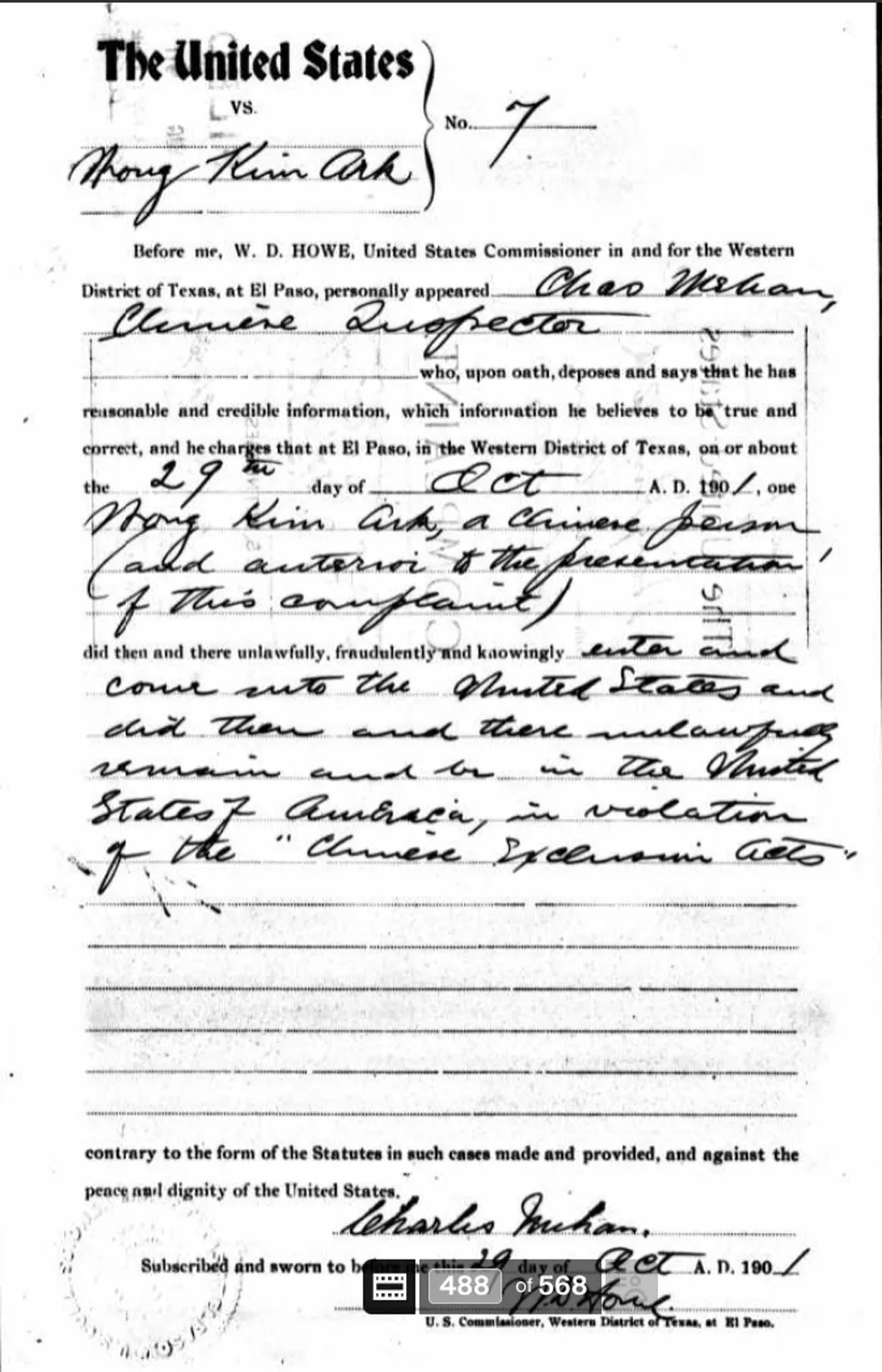
Wong was finally able to return to his life in San Francisco. But it wasn’t always a happy life. After his experience, he feared to travel back to China. That fear proved well-founded. In 1901, he was arrested again in El Paso, Texas on exactly the same grounds: that he wasn’t a true citizen. Once again he spent months proving his citizenship. And his own sons, though legally American through him, found the authorities reluctant to grant them entry.
The Chinese Exclusion Act remained American law until 1943.
But the legacy of the United States v Wong Kim Ark endures to this day. Every child born in the United States, regardless of race or religion, is a citizen, and gains the rights due to any citizen. It’s no longer an assumption. It’s the law of the land.
But we can’t assume it always will be…
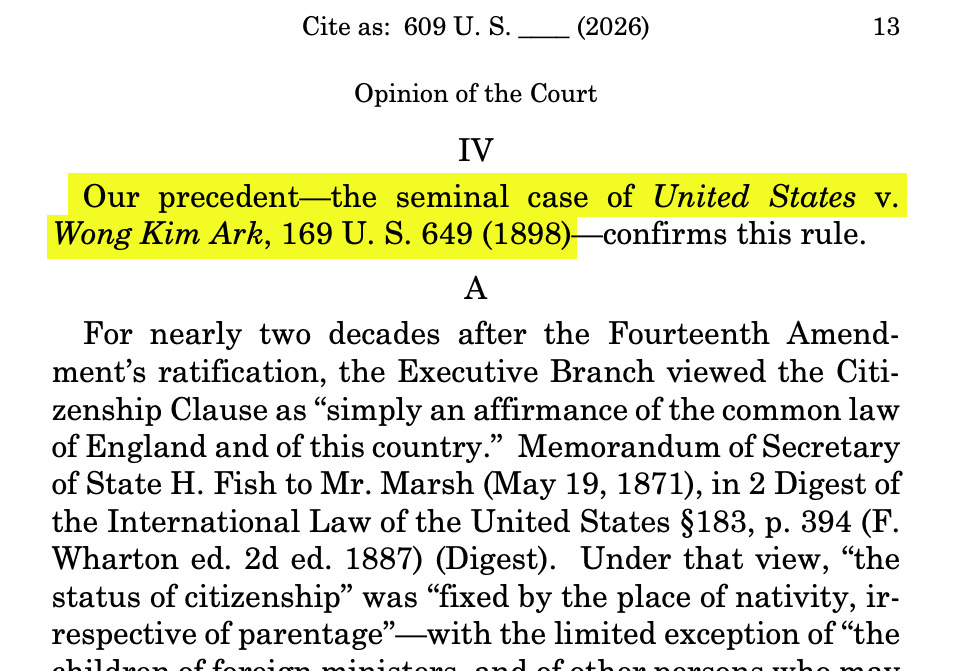
While I was writing this, the U.S. Supreme Court released a new decision, Trump v Barbara. In it, they reaffirmed the principle of birthright citizenship, citing Wong’s case as their core precedent. The story of Wong Kim Ark isn’t just history. It’s current events
In every age, there are those who will — for their own purposes — divide us. Those who seek to deny what people like Wong Kim Ark fought for. Unless we actively strive to shape the future, others will do so on our behalf. And not always to our benefit.
I write about San Francisco and about writing. I’m currently working on my first novel.
If you’re enjoying this, please consider sharing and subscribing.
Sources
NPR Throughline “By Accident of Birth”
Politico: “Birth of a Birthright”
Yale Journal of Law & the Humanities: ““By Accident of Birth: The Battle over Birthright Citizenship After United States v. Wong Kim Ark”
Oldest Vocation: “Family Lawyer”
El Paso Matters, July 4, 2022
American Scholar, “Birthright Citizens and Paper Sons”
Contemporaneous Newspapers
New York Times, 10 March, 1882
San Diego Union and Daily Bee, 1 October 1895
Expositor, 3 January 1896
San Francisco Call, 29 March 1896
San Francisco Call, 14 Nov 1895


Leave a Reply