Introducing the setting for A Philosophy of Air
For those new to my blog, welcome! My name is Marc and I’m writing a novel called A Philosophy of Air, a “naturalistic fantasy.” In these posts, I invite you to join me and learn all about the amazing and fantastical world of the Archipelago.
Today, let’s explore the setting, the Archipelago itself.
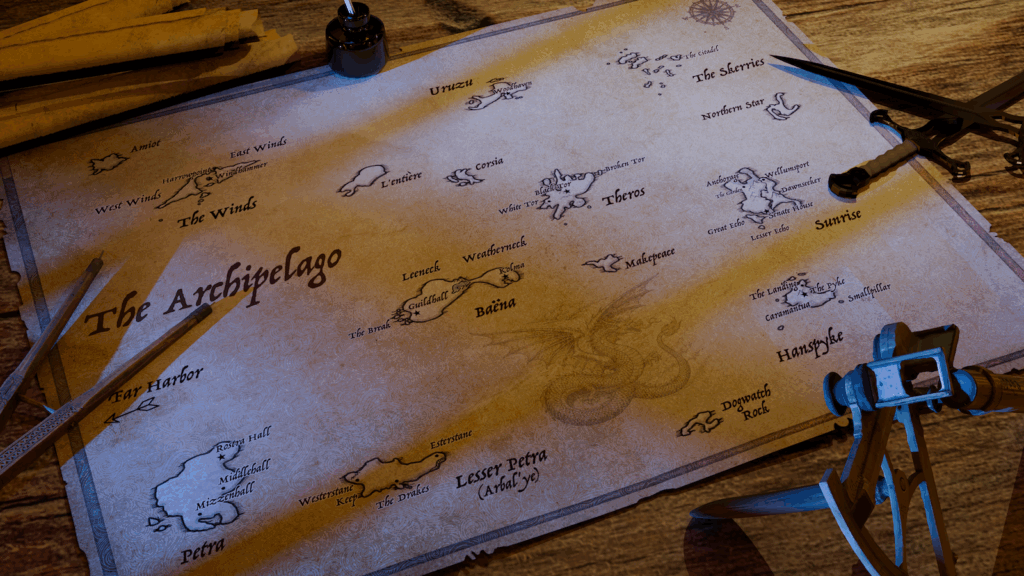
Islands above an acid sea
As the name suggests, the Archipelago is an island chain, only here instead of water, the islands are surrounded by a sea of acidic clouds called the sursus. Now, I’ll dig into the nature of the sursus in a future post, but for right now, just consider it an enormous ocean that you can’t actually sail across, so the inhabitants have learned to navigate in airships.
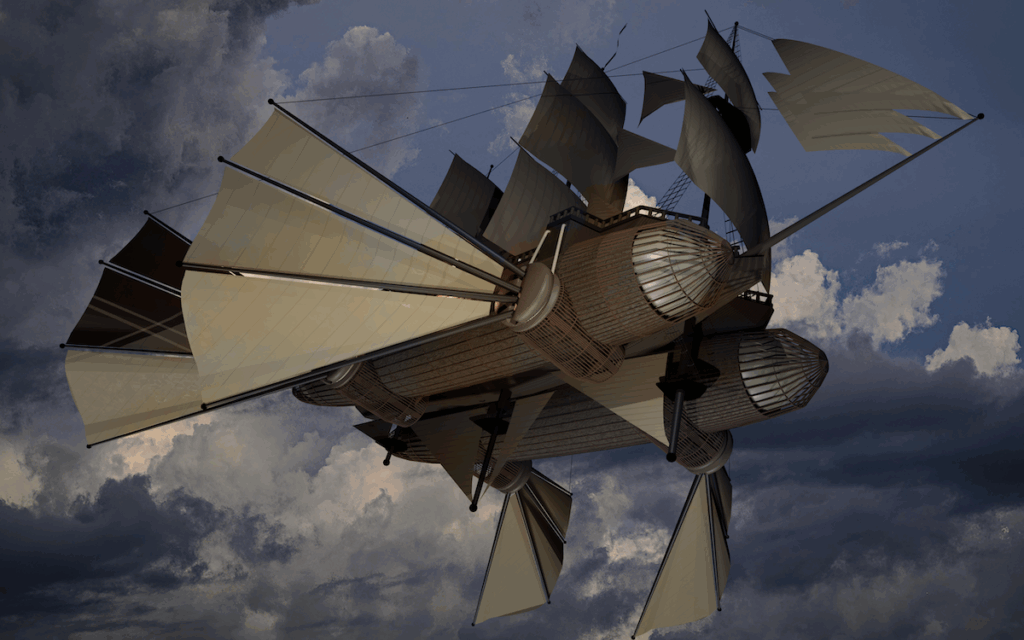
The sursus is a burning acidic expanse, so no one gets too near if they can avoid it. No one can pass through the clouds and live, so no one knows for sure what lies below. The only way to cross is by flying well above.
Do the islands float above the sursus? Are they mountain tops? Something else? No one knows for sure.
The Archipelago has over 100 islands, though there are just a handful of major ones. We’ll dig into the details of each major island in future posts, but today I’ll just introduce you to the major islands and groups.
Southern nations
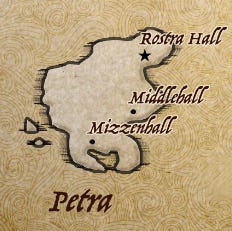
Petra, where our story begins
Our story begins near Petra, the westernmost island in the main body of the Archipelago. As with most nations in the Archipelago, Petra is ruled by a harald, effectively a king, whose seat is at Rostra Hall. The Petran economy is predominantly agricultural, particularly rich in grains like wheat. They practice the One religion, a monotheistic belief system heavily focused on a hero named St. Petra, who, according to myth, could fly even before the invention of airships.
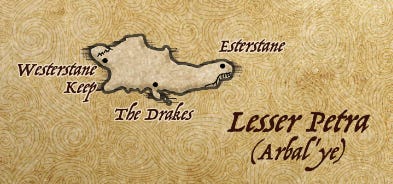
Lesser Petra, home to our main character
Nym, our main character, comes from the neighboring island of Lesser Petra. Now, Lesser Petra was conquered by Petra centuries before our story. Before that, it was called Arbal’ye. But that name, together with the Arbal’yan language, religion, local customs, and anything that smacks of an Arbal’yan national identity, has been forbidden by the Petrans. Lesser Petra is a vassal state to her neighbor, reduced to nothing but a highly taxed agrarian economy. A Petran military governor rules Lesser Petra from the town of Westerstane Keep.
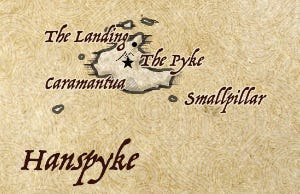
Hanspyke, the garden isle
Moving on, well to the east of Lesser Petra is Hanspyke, a warm and wealthy land ruled by the Hansa family. It was on this island, at a place now called The Landing, where, 912 years before our story, a ship from the island of Sunrise first made contact with the people of another land. This cracks open one of the core mysteries of the Archipelago: humanity appears to have either emerged on various islands independently, or else they somehow arrived there at some unknown moment in their prehistory. No one knows for sure.
Hanspyke is often called the Garden Isle, being rich in fruit, wine, honey, and livestock.
Sunrise, the superpower
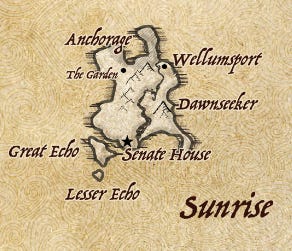
Again moving east, we come to Sunrise, the richest and most powerful of all the islands, where a thousand years ago men first learned to fly airships. It was the great quasi-historical Dawnishman Wellum Strake who “discovered” Hanspyke which brought men of different islands together for the first time. Sunrise is unique among the islands in being a proto-democracy, ruled by a senate and chancellor. It is also home to the largest city in the Archipelago: the great metropolis of Anchorage, which we’ll cover in detail in a future post. The economy of Sunrise is highly diverse, heavy on industry and tradesmen, as well as merchants, intellectuals, and artists.
These first four islands, as a group, comprise a political block known as the Southern Accord, an alliance mostly made up of liberal-minded governments and practitioners of the One religion.
Northern nations
North of here, we come to islands making up the Northern Convention, nations more generally given to conservative ways and less comfortable with — or outright enemies of — the One religion.
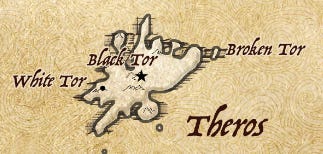
Theros, a warrior tradition
Theros: a haraldry steeped in martial culture and rich in metals such as iron and copper. The Therans practice a warrior’s religion and many amongst them resent the influence of the One religion and other newer ways which have seeped north from the Accord nations.
Uruzu, the forest isle
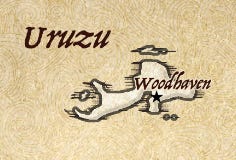
An island covered in forests, Uruzu has furnished the Archipelago with timber for centuries.
The Winds, expert sailors
And The Winds, an island ruled by a theocracy which appoints its harald. It’s a bare, wind-blasted region, but the conditions have led its inhabitants to be regarded as the best sailors in the world.
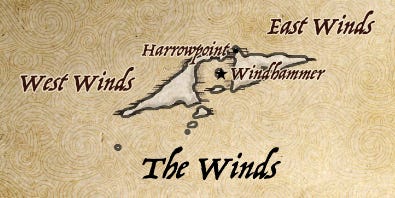
Collectively, these three nations make up the Northern Convention.
The rest of the world
There are a few other island groups to mention.
The Skerries, outside the law
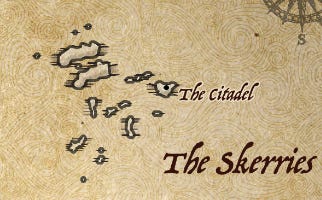
The Skerries is an archipelago within the Archipelago: a collection of islands which serve as a haven for pirates and outlaws. The closest thing to a city in the Skerries is a place called The Citadel, a location where one can find anything…at a price.
Baëna, two nations on a single island
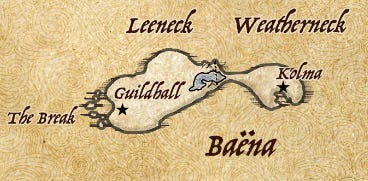
The last major island in the Archipelago proper is Baëna, home to many master craftsmen, and the only island hosting not one but two nations on a single piece of land. To the west is Weatherneck, to the east Leeneck. Both nations have mineral and timber wealth, and they share the largest lake in the known world, making Baëna the only island which produces large quantities of fish. These twin nations attempt neutrality, both with one another and with the larger political blocks.
Far Harbor, an undiscovered country
Finally, there’s one island not on the map, the so-called Far Harbor. Discovered just a few years prior to our story, only a few crews have visited it and it remains largely unmapped and mysterious. And I’m afraid it’s going to remain mysterious to you, too, at least for the time being.
That wraps it up for today! In my next post, I’ll get into some wordplay, ‘cause A Philosophy of Air has a lot to say about words.
Until next time, my friends!
In addition to writing about my work-in-progress novel, I writing about things which interest me, including the city of San Francisco, tourism, and writing itself.
For updates on A Philosophy of Air, please subscribe to my newsletter.
You can also follow me on Substack.
Leave a Reply