(Part I of II)
Ahoy there!
My name’s Marc and I’m writing a fantasy novel called A Philosophy of Air. Picture Master and Commander or Pirates of the Caribbean meets Game of Thrones, all suspended a thousand feet above a sea of poison clouds.
This series takes you inside my worldbuilding journey.
One of my favorite aspects of worldbuilding for this novel has been the conflation of science and fantasy. Both are critical elements of my story’s environment. This week, I’m going to talk all about flight in the world of A Philosophy of Air. What is the “science” of flight in my fantasy world?
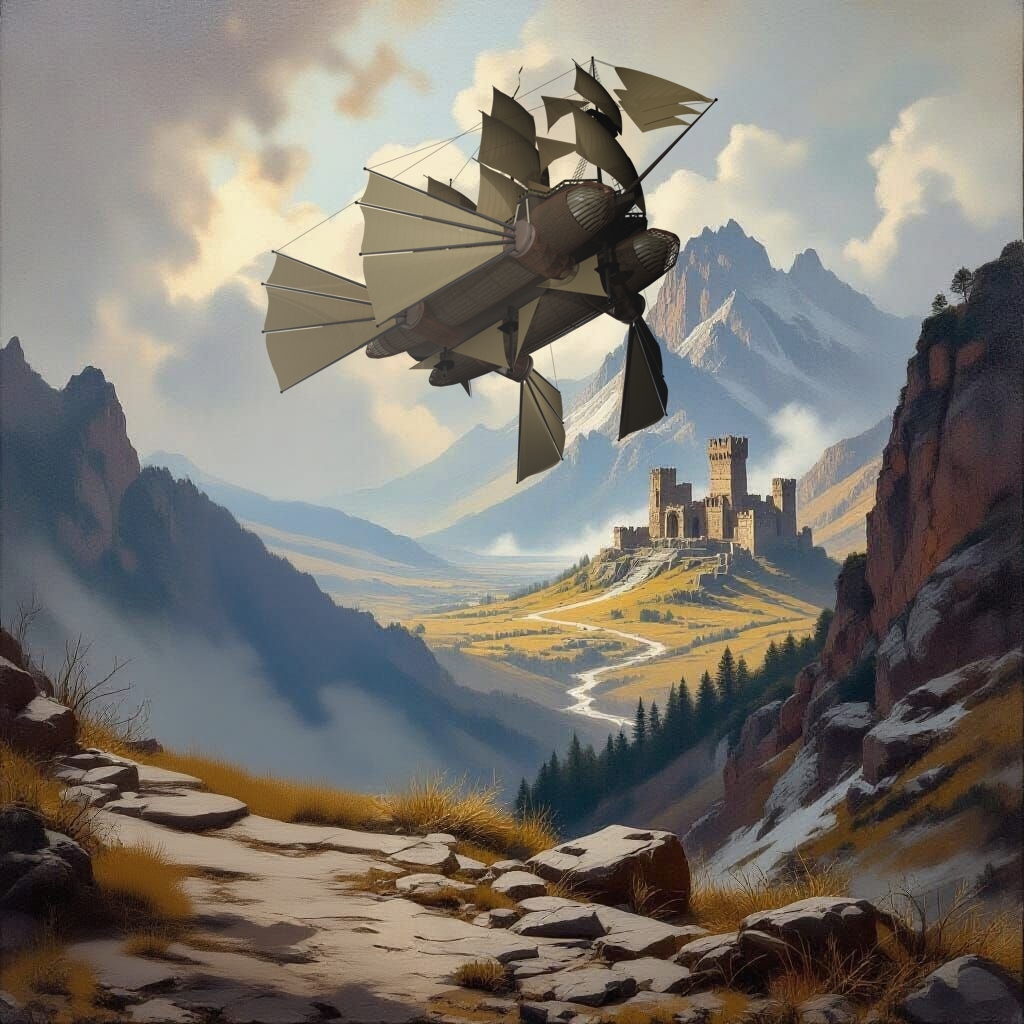
Before we go flying…
Now, let’s get this out of the way upfront:
I’m writing a fantasy novel…not a freakin’ PHYSICS TEXTBOOK. I swear I’ve shared this idea with a couple guys (online, of course) who’ve gone full Comic Book Guy on me…

COMIC BOOK GUY: Well, in fact, the buoyancy forces of a lighter-than-air vessel would never compensate for the mass. Furthermore, one can only sail downwind without the differential pressure expressing the Bernoulli effect against the hull versus that of the air.
Thank you, Myren. Because a man rocketing from the red star of Krypton really would have superhuman strength (and for some reason heat vision?!) under a yellow sun. And Hyperspace, FTL, and Warp Cores are totally believable. And wizards can cast spells alongside dragons, unicorns, and talking trees.
All that’s fine, but a floating ship??!

So let’s just remember: fantasy novel. We’re going to trade a little suspension of disbelief here in exchange for having a good time.
Are we good? OK.
Keeping your airship aloft
So I’ll cover the broad strokes of how airships work in two posts. This one will cover how they stay in the air. The next one will talk about how they move and navigate.
My prior post introduced the concept of the sursus, the acidic clouds that blanket the foot of the world; in essence, a deadly sea.
And in fact it is the sursus itself that provides the lighter-than-air gas — about as close to magic as we get in this story — that allows ships to float.
An old legend states that in some long-forgotten past on the island of Sunrise, a woman named Essen tried to poison her abusive husband by exposing his wine — which he distilled into brandy — to the sursus. But instead of poisoning him, the exposed wine became impregnated with sursic gas. When distilled, the brandy’s flavor changed but the gasses were rendered nonlethal. Essen had inadvertently created a new drink called sureau or “sour water.”

Many centuries later, a distiller whose name is lost to history realized that during the distillation process the noxious fumes which separated from the alcohol yielded a gas with remarkable lifting capacity. This led to airborne vessels, first as a novelty, then as a tool, and eventually, as a means to explore the world beyond the horizon.

A modern airship
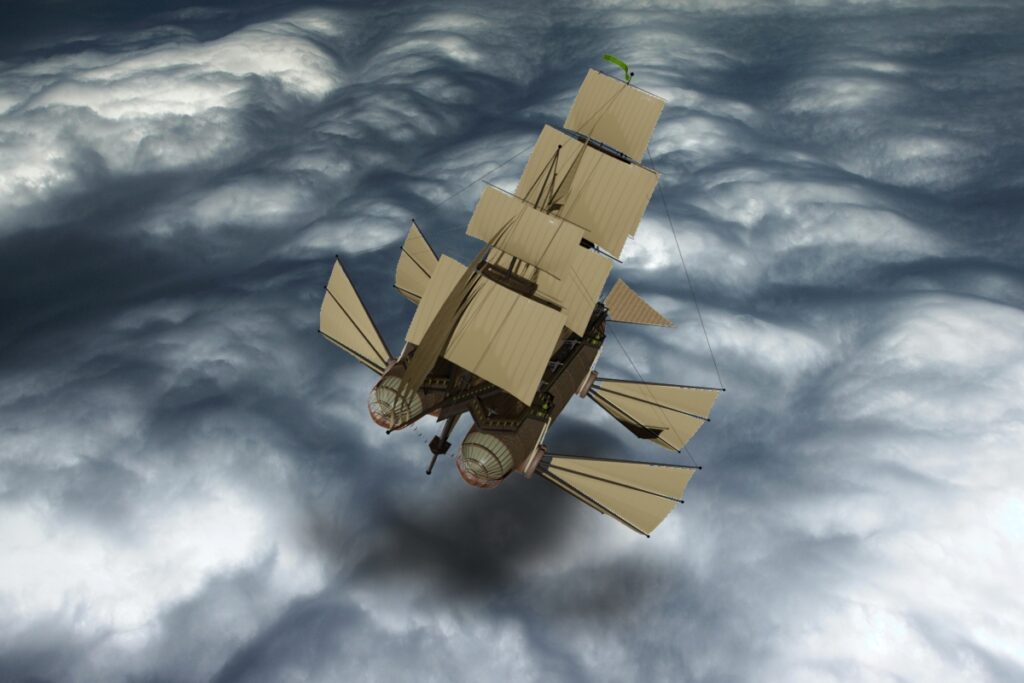
“Modern” airships typically look like a catamaran, with two large sacks slung underneath. These sacks are in fact made up of smaller pockets, cloth-and-tar covered cells called “pallones.” There are hundreds of these in a sack so that leaks or punctures won’t prove catastrophic. That said, sursic gas is highly flammable, so sailors live in fear of fire, and shipwrights — particularly on men-of-war — trade weight for protective housing to make sure the sacks are kept safe.
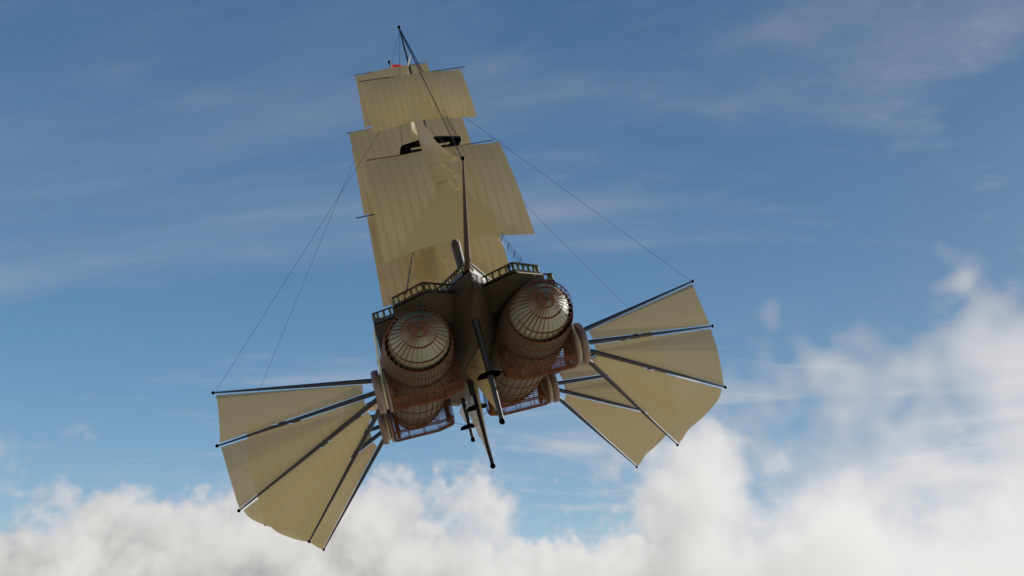
Each sack is a network of smaller “pallones,” the whole surrounded by a protective housing.
You can think of ships in A Philosophy of Air as being buoyancy-compensated like a scuba diver. Sursic gas rises. The ship’s weight pulls down. The result: weightlessness. It then becomes the business of the sails to move the great mass of the ship around.
Which brings us to next week’s topic: using an airship’s sails to move downwind and upwind, and to gain or lose altitude.
Until then, thanks for checking in, my friends.
I write about things which interest me, including my work-in-progress fantasy novel, the city of San Francisco, and writing in general.


Leave a Reply